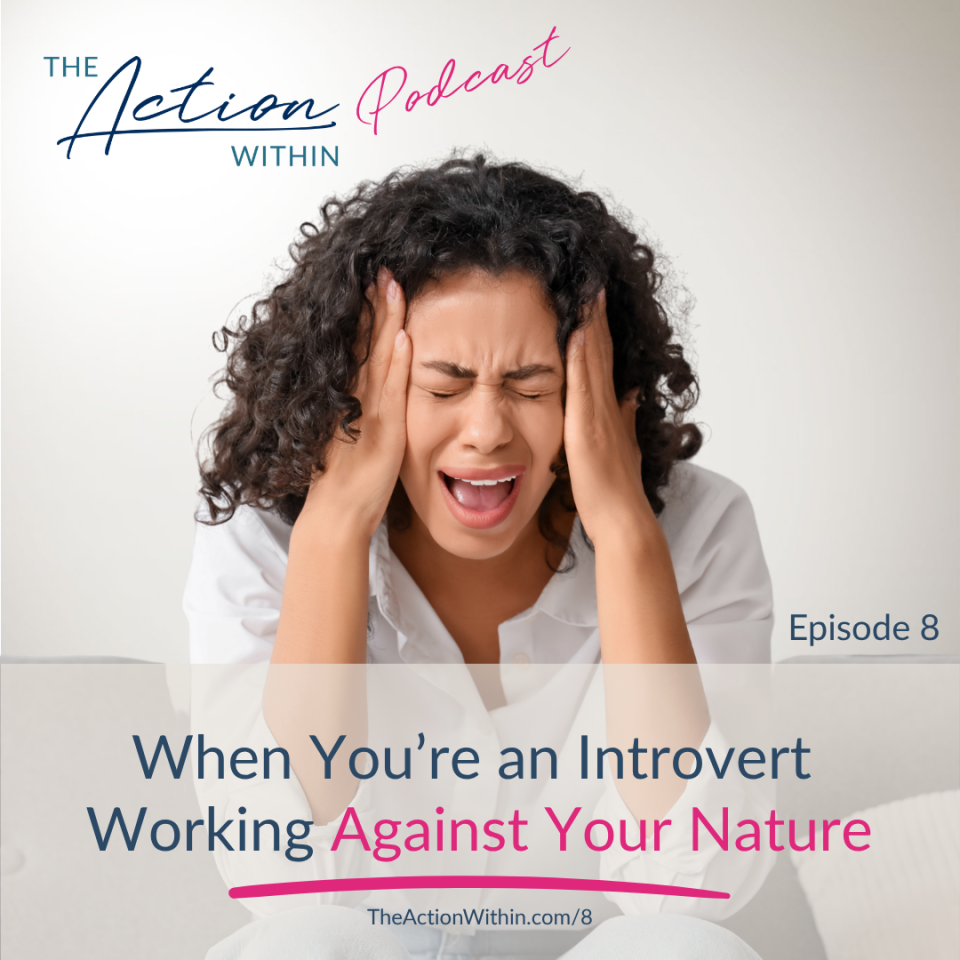
Highly driven women who have not yet recognised they are introverts can find themselves building careers that conflict with their true nature. When you are capable, committed and focussed on delivering, it is easy to keep pushing through loud, pressured and emotionally demanding environments while convincing yourself this is simply what successful work should feel like.
Through four key signs of losing yourself in your work, this episode explores how overworking, emotional exhaustion and fear can keep you disconnected from yourself and stuck in roles that never truly felt right. It also explores the first steps towards better understanding yourself so you can stop pushing against your nature and begin making more aligned choices about your work.
Hello, thank you for joining. Today we are talking about the slow realisation of being an introvert. And how in that process of understanding yourself, you can find yourself in environments that don’t fit you, without even noticing.
When you’re driven, hold high standards and like to deliver, your instinct is to get moving. If something needs doing, you step in and do it.
But that means you can end up on a path before you’ve had the space to ask whether it actually fits you.
Work takes up so much of your life. And over time, it’s easy for your identity to become tied to what you do, how you perform and how you believe others see you.
That identity builds slowly over years. At some point, keeping up with it became the priority, and understanding yourself fell from your focus.
Today, we’ll look at four signs you may be pushing against your nature at work, and how understanding yourself more deeply can help you move towards work that fits who you are.
The full transcript is available at theactionwithin.com/8.
Becoming the Version Work Rewarded
I worked for nearly 20 years before I came to fully understand and appreciate that I was an introvert.
My parents probably could have told you that from the start. And looking back now I can see it. But living it at the time, it wasn’t so clear to me.
As I moved into work, I found myself being swept along. I was capable, confident and personable and those traits were recognised and rewarded.
Over time, how I showed up became my identity.
I pushed my inner feelings down and placed myself in environments that were loud, fast-paced and constantly on. They looked like the right places to be. The kind of environments where someone progressing in their career should succeed.
But the truth is, they wore me down.
At the time I thought the problem was me. That I wasn’t managing myself properly. That I wasn’t making good decisions about how I worked.
But really, I was placing myself in contexts that didn’t suit me, because they looked right, and felt expected.
It felt strained, but I believed that’s just what work was. So I kept going. Showing up each day as who I thought I needed to be.
It’s only now I can see how much I was I was recovering in the gaps in order to start again the next day.
In this state, work became more important than my own needs.
That looked like overworking. Saying yes to everything. Taking on more responsibility without question. Stepping up when no one else did. Leading and engaging large teams, even though it drained me.
If you feel a strong sense of responsibility to do your best at work, it’s easy to end up in a similar place.
Personal needs get sidelined in service of getting things done and delivering what feels expected.
Signs You Are Working Against Your Nature
If this resonates, these four signs will help you recognise where you may be pushing against your nature and why, despite your efforts to make it work, your work has never truly felt like a place where you could be yourself.
SIGN 1: THE WORK-CENTRIC OUTLOOK
When work has become the number one priority, personal and family needs start to fall away.
Not suddenly, but gradually, as work begins to take centre stage.
Work becomes the sun in your sky. Something that feels like it gives you meaning, purpose, a sense of being alive.
And yet, the closer you move towards it, the more it makes you burn.
This happens more easily than it seems. And it’s not unusual.
There may even have been a point where it felt true to say, I love my job.
I said it many times. But looking back, it was a way of convincing myself I was in the right place.
A story that, repeated often enough, began to feel real.
If this feels familiar, here’s some questions to help you reflect:
- How did work come to hold this prioritised place in your life?
- At what point did it move to the centre and what led to that?
SIGN 2: SELF-NEGLECT
Working long or intensive hours, especially in environments that don’t align with your introverted natured, can leave you depleted.
That depletion doesn’t stay hidden. It starts to show up physically, emotionally and psychologically, even when you try to mask it or push through.
It can look like you making more effort with your appearance to feel presentable.
Relying on quick food choices while you work late.
Skipping meals without noticing.
Forgetting basic needs like drinking water during the day, and you reach for whatever gives a quick lift when energy runs out.
In the evening, it might look like you using alcohol to switch off or mark the end of the day. And when you finally do rest, your sleep feels broken or never quite enough.
These are classic self-neglect patterns that show up when you’re overworking and trying to perform in roles that aren’t right for you.
You keep going, compensate and try to stay on top of it. But over time, it becomes harder for you to think clearly about what’s happening, because you don’t have enough reserve left to process it properly.
If this looks like your day, the first step is not a jump to fixing. It’s to fully acknowledge it. To recognise that these patterns are not helping you make decisions that are good for you right now.
When you can see and appreciate that clearly, you can start to make small adjustments, ways for you to restore energy so you can have more capacity to think, feel and respond differently.
SIGN 3: EMOTIONAL NUMBING
You work hard and you work with intensity. But over time, the balance between work and the rest of your life starts to disappear.
To cope with the growing pressure, you begin to detach.
You avoid and shut down.
You switch off emotionally just enough to keep going.
This emotional numbing shows up in what you start to pull away from in your life. It might be family, relationships, connection…even things you used to enjoy.
When you are in burnout and exhaustion from work, parts of you begin to go quiet so you can keep delivering what you believe is required.
Work becomes the sole focus.
You disengage from those around.
You struggle to contribute to conversations because you feel empty or not fully present.
This is a state of survival. And over time, each day can feel like it is reinforcing it.
If you recognise yourself here, or that you are heading in this direction, acknowledgement is again critical.
Reflect on what is creating this state of being for you. Where is the pressure coming from to keep you performing in this way?
That awareness gives you the clarity to start questioning how you work.
Awareness has to come first. It is what allows you to move out of survival mode and begin to recover.
SIGN 4: STAYING OUT OF FEAR
Building a career over years, even decades, feels personal. The identity your role or line of work gives you, can sit deep in your psyche.
And when you have lost yourself in your work, separating who you are from what you do becomes incredibly difficult.
Even when there is a sense that this work no longer fits who you are, it can still feel fixed in place. Hard to step away from. Hard to change.
Fear plays a significant role in why you stay in roles that don’t work for you.
That fear might show up as financial insecurity. A fear of losing credibility. Or a fear of future failure.
Whatever the fear is, it feels real to you. And because it feels real, it holds you in place.
It keeps you in work that isn’t right for you, and it limits how fully you can use your personality and skills in a way that feels more like you.
Coming to terms with the main fear that is holding you back is important, because fear narrows your thinking and destabilises your sense of direction.
Start by questioning what sits underneath that primary fear.
Exploring and understanding where that primary fear originates from, gives you perspective. And from that perspective, you can start to understand what needs attention so you can shift your outlook and move forward.
Returning to Yourself
Carl Rogers once said:
“The curious paradox is that when I accept myself just as I am, then I can change.“
This is the moment to look more closely at how you are showing up in your work, how you perform, how you fit in, and how you present yourself.
Coming to terms with being an introvert and what that means for you professionally can be a turning point.
From there you can start to align your work more closely with who you are, own your true ambition and stop pushing against your nature.
Some further questions to reflect on:
- When are you working against your true nature?
- Where does that lead you?
- How is your current path serving what you actually want from life?
Today’s focus helps you acknowledge yourself in ways you may not have done before.
It may also bring you closer to thinking about a professional change, and what might need to shift for you to get there.
Give yourself space to sit with all the questions from today’s episode.
Let your thoughts move without forcing them into answers too quickly, and notice where they take you.
Further support is available at TheActionWithin.com including a free detailed guide to help you know and understand yourself, as well as next steps if you need some support to move forward.
And if you found this episode helpful, I would be very grateful if you could leave a rating and review.
Your support helps The Action Within Podcast reach other women who are in a similar place, questioning who they are, their work choices, and realising something has to change.
And remember, trust yourself enough to choose yourself.